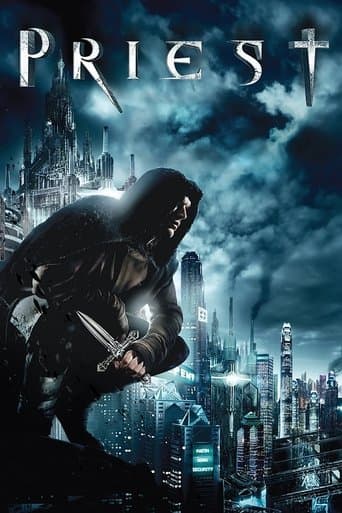
In an alternate world, humanity and vampires have warred for centuries. After the last Vampire War, the veteran Warrior Priest lives in obscurity with other humans inside one of the Church's walled cities. When the Priest's niece is kidnapped by vampires, the Priest breaks his vows to hunt them down. He is accompanied by the niece's boyfriend, who is a wasteland sheriff, and a former Warrior Priestess.
"Priest," directed by Scott Stewart and released in 2011, presents a unique blend of dystopian science fiction and horror, showcasing a world where humanity has triumphed over vampires through centuries of warfare. The film explores profound themes of faith, sacrifice, and the struggle against oppressive systems. The protagonist, a Warrior Priest, embodies the conflict between personal desires and societal obligations, as he defies the Church’s dogma to rescue his niece. This internal battle reflects a broader commentary on the nature of belief systems, questioning the morality of institutions that prioritize control over individual lives and the lengths to which one will go to protect family, even at the expense of one's own vows.
Culturally, "Priest" taps into the zeitgeist of its time, drawing from the burgeoning interest in vampire narratives that began with the success of franchises like "Twilight" and "True Blood." However, unlike the romanticized portrayals of vampires, "Priest" opts for a darker, more action-oriented take, aligning with the resurgence of dystopian themes in contemporary cinema. The film's stylistic choices and narrative structure resonate with viewers who crave escapism through intense action sequences and visual flair, which can be seen as a reflection of society's own struggles against perceived threats, whether they be physical or ideological.
The cinematography of "Priest" is particularly noteworthy, as it employs a striking visual style that blends graphic novel aesthetics with a gritty, post-apocalyptic atmosphere. The film’s palette is dominated by dark hues and stark contrasts, enhancing the otherworldly feel of the vampire-infested wastelands and the oppressive environment of the Church's city. The use of 3D technology, although not universally praised, adds a layer of immersion, allowing audiences to experience the high-octane action sequences in a visually dynamic way. This stylistic approach helps to reinforce the film's tone, making the viewer feel the weight of the Priest's journey and the horrors he confronts.
From a production standpoint, "Priest" faced both challenges and unique opportunities, notably in its adaptation process from the Korean comic series created by Min-Woo Hyung. The film's production design needed to balance fidelity to the source material with a cinematic vision that could appeal to a wider audience. This resulted in a distinctive mix of gothic horror and futuristic elements, where ancient cathedrals coexist with advanced technology. The film's budget, estimated at around $60 million, reflects the high stakes involved in bringing such a visually ambitious project to life, culminating in a movie that, while divisive among critics, remains a compelling entry in the realm of supernatural action films.