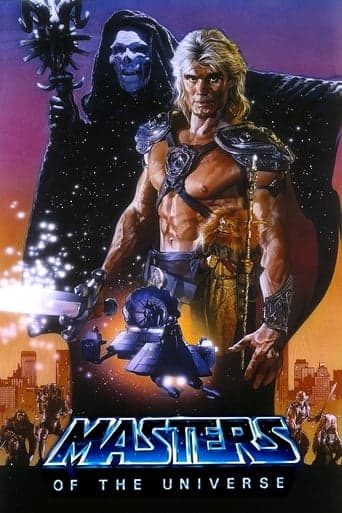
When the evil Skeletor finds a mysterious power called the Cosmic Key, he becomes nearly invincible, seizing Castle Grayskull and the surrounding city. The Sorceress is now Skeletor's prisoner and he begins to drain her life-force as he waits for the moon of Eternia to align with the Great Eye of the Universe which will bestow god-like power upon him. However, courageous warrior He-Man locates the locksmith inventor Gwildor, who created the Key and has another version of it. During a battle, one of the Keys is transported to Earth, where it is found by teenagers Julie and Kevin. Now, both He-Man and Skeletor's forces arrive on Earth searching for the potent weapon.
"Masters of the Universe" (1987) stands out as a fascinating blend of fantasy and science fiction, reflecting the era's cultural zeitgeist. The film, based on the popular toy line and animated series, encapsulates the battle between good and evil through its central characters, He-Man and Skeletor. At its core, the movie explores themes of courage, friendship, and the struggle for power. The juxtaposition of the mystical world of Eternia with the mundane reality of Earth speaks to the universal quest for identity and heroism, particularly during the 1980s when consumerism and individualism were at their peak. This thematic dichotomy resonates with audiences who yearn for escapism while grappling with their own realities.
The film's production history is as intriguing as its narrative. Directed by Gary Goddard, "Masters of the Universe" faced numerous challenges, including budget constraints and a tight shooting schedule. Originally intended to be a grand epic, the filmmakers had to make significant compromises, resulting in a more grounded take on the fantastical source material. The production took place in California, with sets designed to evoke the iconic landscapes of Eternia, yet the film's reliance on practical effects and modest budgets led to a mixed reception. Despite this, it has become a cult classic, demonstrating how creative constraints can sometimes yield unique and memorable cinematic experiences.
Cinematographically, the film offers a distinctive visual style that reflects the late '80s aesthetic. With vibrant costumes and elaborate set designs, the film captures the larger-than-life essence of its characters. Cinematographer Thomas Del Ruth employed various techniques to enhance the film's fantastical elements, utilizing colorful lighting and dynamic camera angles to create a sense of adventure. The contrast between the gritty urban landscape of Earth and the vivid, otherworldly realm of Eternia serves to heighten the stakes of the characters' quest. This visual storytelling complements the film's themes, reinforcing the notion that heroism can emerge from the most unexpected places.
Despite its mixed critical reception upon release, "Masters of the Universe" has left a lasting cultural impact. It not only introduced a generation to the world of He-Man but also became emblematic of '80s pop culture, inspiring a devoted fanbase that continues to celebrate the film through conventions, merchandise, and social media. The film has also influenced various adaptations, including animated series and comic books, as well as a recent resurgence in interest thanks to the Netflix reboot. This enduring legacy reflects the film's ability to resonate with audiences and highlights the timeless appeal of its central conflict between good and evil, making it a significant entry in the canon of fantasy cinema.