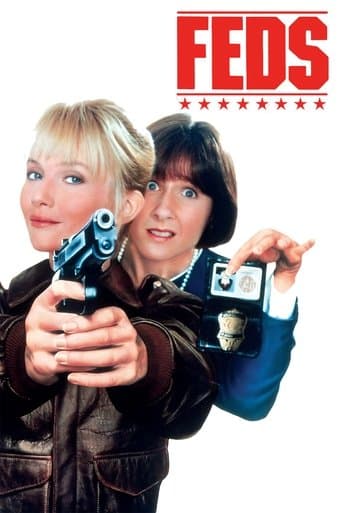
Ellie DeWitt and Janis Zuckermann are admitted to the very strict FBI Training Academy. They get a hard course, in which they learn to deal with guns and to recognise crimes. They also get a physical training. It appears that Ellie is a real fighting- machine, in contrast with Janis, the great student. They have to help each other, all the way to graduation.
"Feds!" (1988) is an intriguing blend of comedy and coming-of-age themes, centering on the experiences of two women navigating the rigorous and traditionally male-dominated world of the FBI Training Academy. The film deftly explores the concept of female empowerment, showcasing how Ellie DeWitt and Janis Zuckermann, played by Rebecca De Mornay and Mary Gross, respectively, challenge stereotypes. Their journey highlights the importance of camaraderie and mutual support, emphasizing that success often comes from collaboration rather than competition. Through their contrasting personalities—Ellie's tough, physical prowess and Janis's intellectual approach—the film delivers a message about the diverse strengths women bring to the table, illustrating that there’s no single path to success.
From a cultural perspective, "Feds!" arrived during a pivotal moment in the late 1980s when society was beginning to confront issues surrounding gender equality and women's roles in the workplace. While the film may not have achieved the same iconic status as other comedies of its era, it contributed to the conversation about women in law enforcement and the breaking down of gender barriers. The portrayal of female leads in a law enforcement setting, especially in a comedic light, was progressive for its time, reflecting the shifting perceptions of women's capabilities in fields previously dominated by men. This film, though often overlooked, played a small but significant role in paving the way for future representations of women in action and law enforcement narratives.
Cinematographically, "Feds!" adopts a straightforward visual style typical of late '80s comedies, yet it effectively captures the intensity of the FBI training experience. The directors, such as the seasoned veteran Paul Schneider, utilized various training sequences to build a sense of realism, interspersing moments of levity with the rigorous demands placed upon the characters. The cinematography effectively contrasts the high-pressure environment of the academy with the lighter, more humorous moments, creating an engaging balance that keeps the audience invested in both the characters’ trials and their triumphs.
Production-wise, "Feds!" faced the challenge of being a comedy that also aimed to tackle serious themes about law enforcement and gender roles. The filmmakers sought to maintain a light-hearted tone while ensuring the authenticity of the FBI training experience was not compromised. This balancing act was crucial in appealing to a wide audience, particularly during a decade when audiences were increasingly drawn to films that offered both entertainment and social commentary. Despite its moderate box office performance, "Feds!" remains a noteworthy entry in the genre of buddy comedies, particularly for its attempt to blend humor with the complexities of women's roles in a challenging profession.